


LuxuRigen™ — ReLusso’s method for regenerated signed jewellery
Every signed piece that enters ReLusso carries a history. A Cartier Love bracelet, a Bulgari B.Zero1 ring, a Tiffany & Co. necklace — acquired from private owners, sometimes pristine, sometimes bearing the quiet marks of time. Before reaching its next owner, each piece must pass through a process that has nothing to do with a quick polish at a standard jewellery shop. It must be assessed by a trained gemologist, not a shopkeeper. It must be regenerated with method and precision. LuxuRigen™ is the proprietary protocol developed by Valerio Saltari — Graduate Gemologist certified by the IGI in Antwerp, with over 15 years in the high jewellery sector — to do exactly that: return every signed piece to the presence, brilliance and desirability it deserves.
In the market for regenerated luxury jewellery, anyone can claim to “clean and refurbish”. LuxuRigen™ is different: a structured 5-stage process with precise selection criteria, in-depth technical analysis and a final double sterilisation that no other operator in the sector has standardised in this way.
Why LuxuRigen™ was created
The pre-owned signed jewellery market has a trust problem. When someone buys a pre-owned Cartier or a regenerated Pomellato Nudo, they need certainty: the piece is authentic, its condition is as described, and there are no surprises hidden beneath a surface shine. LuxuRigen™ is ReLusso’s answer to that problem.
The method was built from direct experience: years of gemological assessments, thousands of pieces examined under professional magnification, and the understanding that a regenerated signed jewel is worth more than a used one — but only when the regeneration is performed to precise, verifiable standards. LuxuRigen™ is the formalisation of those standards.
Regenerated is not the same as refurbished
In common usage, “regenerated” and “refurbished” are often treated as synonyms. For signed luxury jewellery, they are not. Refurbishing means returning an object to an acceptable functional state. Regenerating, in the LuxuRigen™ sense, means restoring a piece to its full aesthetic and structural potential — with the understanding that a Cartier Love bracelet or a Bulgari Serpenti is not an object to be “repaired”, but a creation to be honoured.
This requires a fundamentally different approach: no intervention that compromises the brand’s identity, no finishing that alters the original proportions of the design, no component replacement that isn’t original or a certified equivalent. Respect for the object is built into the method.
The 5 stages of the LuxuRigen™ method
1. Rigorous selection
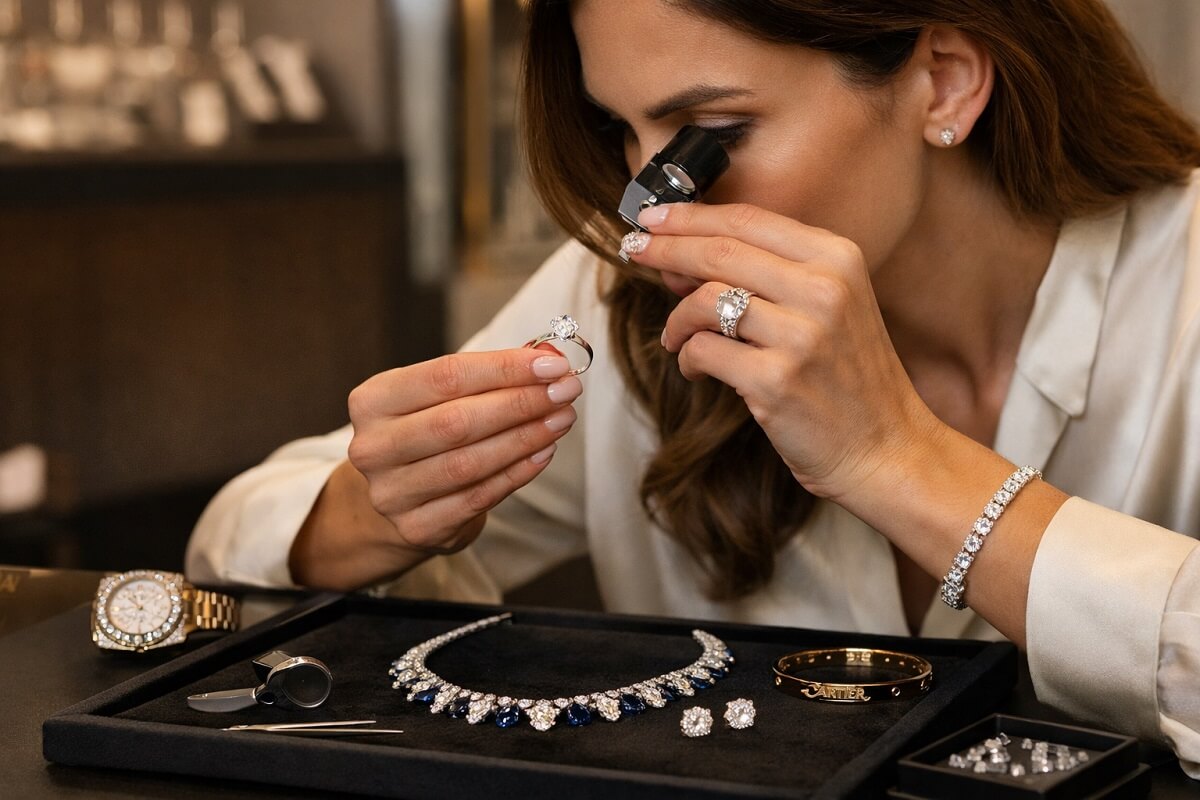
LuxuRigen™ begins before the piece enters the workshop. Selection is not an administrative formality — it is the filter that defines the quality of the entire ReLusso collection. Each piece is assessed against six criteria: structural integrity, setting condition (checking for loosened or missing prongs), clasp function, legibility of the brand’s hallmark, overall aesthetic balance and the market desirability of the specific reference. A signed piece that doesn’t pass this stage simply doesn’t enter the process. No exceptions.

2. Gemological quality analysis
This is the stage that defines ReLusso’s standard in the regenerated jewellery market. Technical analysis is conducted using the instruments and expertise of an IGI-certified gemologist: metal alloy verification (18kt gold, 9kt gold, platinum, 925 silver), stone assessment — nature, any treatments, prong and pavé integrity, and surface condition of diamonds. For signed pieces, the hallmark and engraving characters are also checked for consistency with the maison’s known standards, and — where available — the serial number is matched against the original purchase warranty. No piece proceeds to the next stage until this analysis is complete and documented.

3. Regeneration and deep cleaning
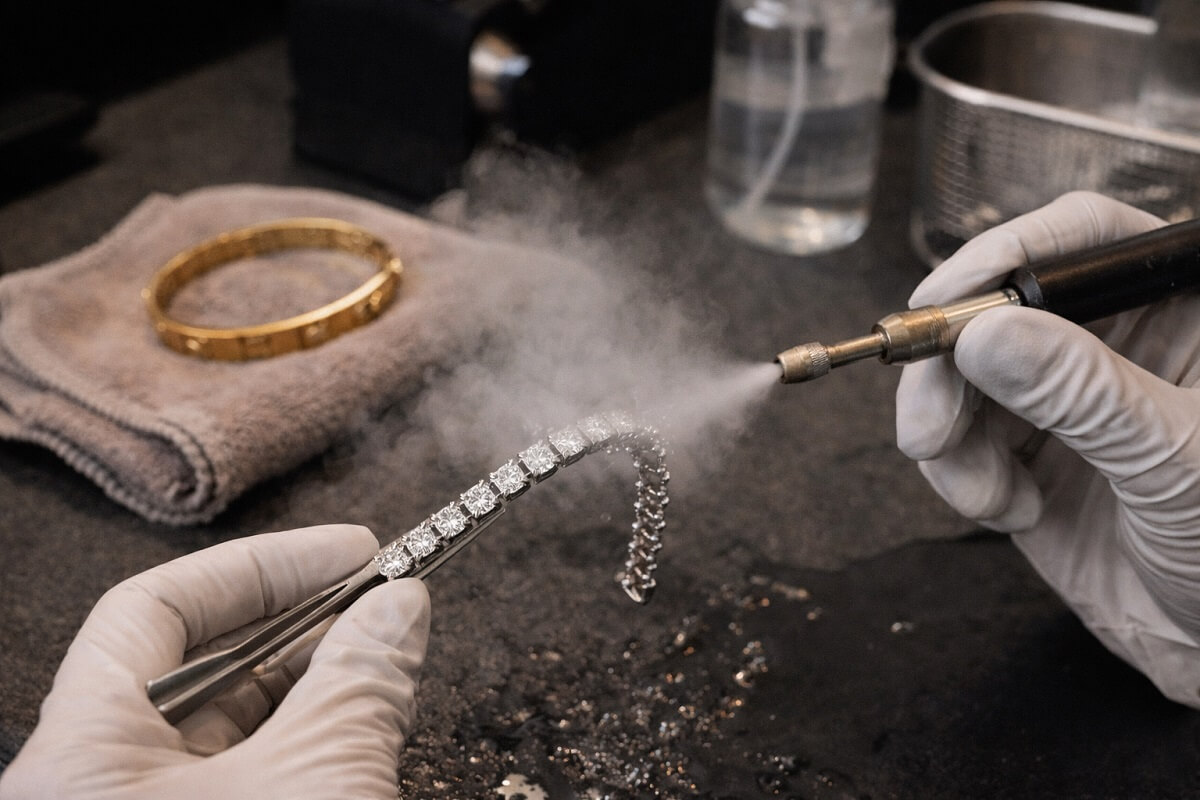
The actual regeneration happens here. This is not a matter of soaking the piece in a solution and waiting — the process is differentiated by material, type of residue and the specific architecture of each piece. Precious metals are treated with cleaning methods appropriate to their alloy. Stones receive treatment calibrated to their type: a diamond pavé, a coloured cabochon and a pearl each require a different approach. High-accumulation zones — settings, chain links, clasp hinges — are addressed with precision instruments. The benchmark for this stage is measurable: the piece must recover its original luminosity uniformly, without any alteration of surfaces.
4. Precision finishing
Every maison has its own surface language. Cartier uses selective satin finishes on specific elements that must not be polished; Bulgari has twisted surfaces requiring care at transition zones; Tiffany & Co. works with sterling silver with specific patinations. The precision finishing stage of LuxuRigen™ accounts for these specificities. The goal is not to make every piece look the same — it is to restore each piece to the presentation the maison conceived for that specific design. This is where the gemologist’s eye shifts to an aesthetic one, and where the difference between a clean result and a truly premium presentation becomes immediately visible.

5. Double sterilisation
The fifth stage is what has made LuxuRigen™ distinctive in the sector. Double sterilisation is not a cosmetic touch — it is a two-phase sequential hygiene protocol designed to ensure a high, certified standard of hygiene. The first sterilisation treats organic residues accumulated through wear; the second operates once the cleaning cycle is fully complete, ensuring the piece arrives with certified hygienic integrity. Whoever wears a ReLusso regenerated jewel is not wearing a “used and cleaned” piece. They are wearing a piece treated with the same level of care a maison would apply to something leaving its own manufacture.
What you receive when you buy a LuxuRigen™ piece
Every piece carrying the LuxuRigen™ mark has been selected against precise criteria, analysed by a certified gemologist, regenerated in depth, finished in accordance with the maison’s identity and subjected to double sterilisation. It is not a piece that is “like new” — it is a regenerated piece held to a higher standard, with an authentic history and a quality guarantee that the pre-owned signed jewellery market rarely delivers at this level.
The difference is felt not only at the moment of purchase. It is felt every time the piece is worn — in the brilliance that hasn’t faded, in the stones that stay where they belong, in the clasp that opens and closes perfectly. That is the real measure of LuxuRigen™.
What makes LuxuRigen™ different
Three elements distinguish LuxuRigen™ from any other treatment process for pre-owned signed jewellery — and none of them can be replicated with a standard formula.
The first is gemological expertise at the centre of the process, not at the margins. Valerio Saltari is a Graduate Gemologist certified by the IGI in Antwerp — one of the most rigorous technical qualifications in the field — and registered with the Italian OAM under number OCO1836. This means that the technical assessment of each piece is performed by a professional who understands the difference between a treated and a natural diamond, between a synthetic and a Burmese ruby, between a genuine brand hallmark and an imitation.
The second is respect for maison identity. LuxuRigen™ does not standardise. It works with the specificity of each brand and each reference, because a signed jewel loses value the moment it loses its original character.
The third is double sterilisation as a non-negotiable standard, not a premium option. Every piece, regardless of its value, receives the same final protocol. There are no shortcuts in LuxuRigen™.
Regenerated luxury jewellery at ReLusso
LuxuRigen™ applies to every brand in the collection: from regenerated Cartier bracelets and rings to Bulgari rings and necklaces, through to Tiffany & Co. jewellery and Italian maisons including Pomellato, Chantecler and Pasquale Bruni. Every piece on sale at ReLusso has completed all 5 stages of the protocol — without exception.
Frequently asked questions about LuxuRigen™
Is a LuxuRigen™ regenerated piece different from a used piece?
Completely. A “used” piece is one sold in the condition it’s in after previous ownership. A LuxuRigen™ regenerated piece has been through gemological selection, technical analysis, deep regeneration, maison-specific precision finishing and double sterilisation. The result is a high aesthetic and hygienic standard — while preserving the authenticity and history of the original.
If regeneration starts with a technical analysis, how exactly is authenticity verified?
Authenticity verification is an integral part of Stage 2 of the LuxuRigen™ method. The brand hallmark and engraving characters are checked against the maison’s known standards, the material quality is assessed, and — where available — the serial number is matched against the original purchase warranty. This analysis is conducted by Valerio Saltari, Graduate Gemologist certified by the IGI in Antwerp, using professional instruments. Pieces that do not pass the authenticity check are not purchased or listed for sale.
And if the piece has delicate stones, like pearls or emeralds — does that change the treatment?
Yes, and that’s exactly why gemological analysis always precedes regeneration. Stones sensitive to heat, moisture or solvents — pearls, coral, opals, certain treated coloured gems — receive specific treatment that excludes aggressive cleaning methods. Stage 3 of LuxuRigen™ is designed to adapt to the composition of each individual piece, not a single protocol applied indiscriminately.
With such a differentiated process, how long does LuxuRigen™ take for a single piece?
It depends on the complexity of the piece and the specific treatments required by the earlier stages. A plain band ring takes less time than a pavé-set bracelet or a multi-component necklace. On average, all 5 stages are completed in 2 to 5 working days per piece. ReLusso does not compress timelines for volume — each piece receives the time its regeneration genuinely requires.
