


Trinity de Cartier: history, meaning and iconic jewelry

Three golds, one idea: the origins of Trinity de Cartier
In 1924, Louis Cartier did something unusual for a maison built on diamonds and precious stones: he designed a ring with no gems at all. Three slender bands of yellow gold, white gold and rose gold, interlocked so that each one moved around the others while remaining free. No stone, no setting, no decorative element added. The form was the object. That ring was called Trinity, and it has never left the Cartier catalogue since — one hundred years of unbroken production, a record no other collection in the maison’s history can match.

The origins of Trinity are bound up with the poet and artist Jean Cocteau, a central figure in the Surrealist Paris of the 1920s. Cocteau wanted a piece of jewellery with emotional weight — something that spoke through form rather than through the value of its stones. Louis Cartier answered with three interlocked bands: a geometric idea that contained a symbolic one. The result was so unlike anything Cartier had made before that American Vogue noticed immediately, publishing a mention in 1925 of “the very new Trinity bracelet and ring.” For a maison accustomed to being praised for the quality of its stones, being celebrated for a plain gold ring was confirmation that something new had happened.
The quiet provocation behind Trinity was precise: in a catalogue where a jewel’s value depended on its stone content, Cartier declared that a jewel could exist whose entire value lay in the idea. The three-gold band cost what it cost not because it carried diamonds — but because it was Cartier, and because it was brilliant. That position has not changed in a hundred years.
The meaning of the three metals: yellow gold, rose gold, white gold
Tradition holds that each of the three bands carries a distinct meaning. Yellow gold represents fidelity: the metal that does not oxidise, that holds its colour through time, associated with the solidity of a lasting commitment. Rose gold evokes love — the warm tone that jewellery has long associated with intimacy and tenderness. White gold carries friendship, cooler and more neutral, the bond that holds without weighing.
Cartier has never officially fixed this symbolism in any definitive way, and that ambiguity is probably intentional. It allows whoever wears Trinity to assign it whichever meaning they choose. Jean Cocteau wore two Trinity rings stacked on his left little finger; the Duke of Windsor did the same. Neither needed to explain what they meant. Trinity works without a translation.
What does remain fixed is the mechanics: the three bands move relative to one another but stay integrated, each one simultaneously above and below the other two at different points along the circumference. It is a construction that seems to defy geometry — three rings interlocked with no definitive top or bottom. That sense of fluid, coherent movement is why Trinity is so difficult to imitate convincingly. Fakes are often caught here: the bands do not slide, or they slide unevenly.
From ring to universe: the formats of the collection
The bracelet was born the same year as the ring, in 1924. Cartier understood immediately that the three-band motif could scale to other formats without losing legibility. Over the course of the twentieth century the collection expanded to cover almost every category of jewellery, always keeping the three-band signature as its guiding thread.

The Trinity ring: small, classic and large models
The ring is the founding piece and still the most sought-after in the secondary market. Cartier produces it in three main proportions: the small model (overall width approximately 6 mm), the classic model (the original format, slightly wider) and the large model. The three bands are identical in width within each model — it is the overall proportion that varies, not the ratio between the metals.
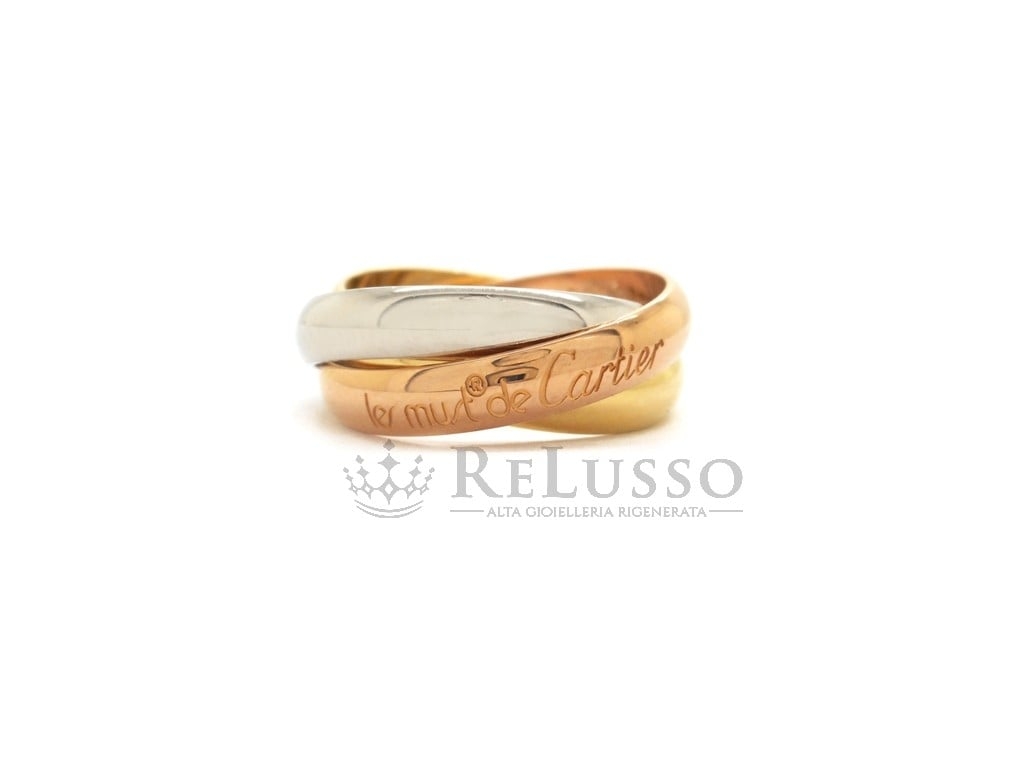
There are also versions with diamond pavé on one or more bands, introduced systematically by Cartier from the 2000s onwards. The pavé diamond on the white gold band is the most common variant; the version with all three bands set remains a piece of high jewellery. In 2024, for the collection’s centenary, Cartier reintroduced variants with a cushion-shaped profile — a reference to the volumes of the 1970s.
In the pre-owned market, the small model Trinity ring in tricolour gold without diamonds is the most actively traded piece in the collection. Its liquidity in the secondary market is comparable to that of the Love bracelet — not identical, but in the same category of immediate recognisability.
The Trinity bracelet
The bracelet is the collection’s other pillar. Its structure follows the same principle as the ring — three interlocked bands — but in rigid format, with a hinged opening. It is available in multiple sizes (internal diameter typically ranging from 45 to 64 mm) and in plain or diamond-set versions. Cartier also produces a version with a black cord woven between the bands, which shifts the piece towards a more contemporary and less formal register.
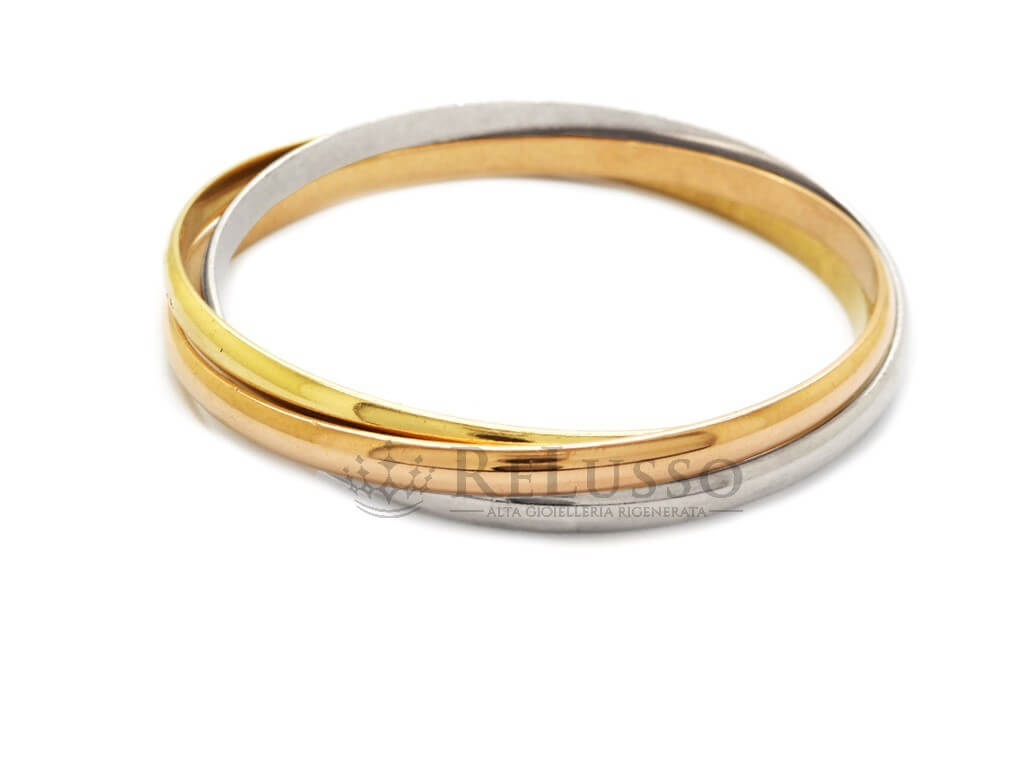
The medium Trinity bracelet is the format that sees the greatest demand in the pre-owned market. The most common sizes in secondary market listings run between 50 and 58 mm; pieces at the extremes of the size range tend to move more slowly.
Necklaces, earrings and cufflinks
The Trinity necklace uses the three-band motif as a pendant on an 18kt gold chain, typically in tricolour. There are versions with a compact pendant (easier to wear daily) and versions where the motif is integrated into the chain structure itself. Earrings render the theme both as a hoop, where the three bands make up the entire earring structure, and as a drop format.

Trinity cufflinks occupy a niche but significant place, particularly in the men’s pre-owned market. Trinity is one of the few Cartier collections with an established presence in men’s accessories — the three-gold cufflinks are immediately recognisable and attract a consistent clientele.
One hundred years without a compromise: why Trinity endures
Few jewels survive a hundred years of continuous production without being repositioned, watered down into cheaper versions, or redesigned to chase a trend. Trinity has remained essentially unchanged since 1924. The diamond variants, the new proportions, the extensions into new formats have never touched the core of the design: three bands, three golds, fluid movement.
Trinity’s longevity rests on at least two factors that rarely coexist. The first is symbolic neutrality — a jewel that can mean friendship, love, fidelity, or simply elegance reaches an audience that is not tied to a single occasion. It is not an engagement ring, nor a wedding band, nor a graduation gift: it is all of these things and none of them. The second is visual durability: three bands in three colours of gold are legible at a distance, identifiable in a fraction of a second, and extremely difficult to imitate convincingly. That legibility does not depend on size — a 6 mm Trinity ring is as recognisable as a bracelet.
Jean Cocteau wore his Trinity on his little finger as a sign of belonging to a particular understanding of luxury — not ostentatious, not didactic, but precise. It has stayed that way. Whoever wears a Trinity today knows that gesture is a hundred years old.
Pre-owned and regenerated Trinity de Cartier: the ReLusso experience
Trinity is among the five Cartier pieces that pass through the ReLusso boutique most frequently. It is not a surprise: it is the Cartier jewel with the lowest risk profile for anyone buying in the secondary market. No stones to assess, no mechanism to check, no setting to examine — only 18kt gold and a precise mechanics that reveals immediately whether it works as it should or has been tampered with.
The models we see most regularly in the catalogue are the small and classic ring in tricolour without diamonds, the medium bracelet, and the necklace with three-band pendant. Rings with pavé on one band appear less frequently but attract consistent demand. Trinity cufflinks come into the boutique occasionally and are absorbed quickly.
On pricing in the pre-owned market, a Trinity small model ring in good condition with original Cartier documentation sits indicatively between €1,200 and €1,800, depending on year of production and surface condition. The classic model with pavé on one band rises indicatively to €2,500–€4,500. The medium tricolour bracelet ranges between €2,800 and €4,500. These ranges reflect current market conditions — they are not fixed quotations and vary with gold prices and the availability of documented pieces.

The LuxuRigen™ checkpoints specific to Trinity cover three main areas. The first is band mechanics: each band must slide fluidly and evenly relative to the other two; any irregularity in movement signals a prior intervention, deformation, or counterfeit. The second is internal hallmarking: each authentic band carries the Cartier mark, the 750 hallmark for 18kt gold, and a serial number — three separate marks, one per band, verifiable under magnification. The third is band geometry in cross-section: round on the outside and flat on the inside, with the Cartier name engraved on the rose gold band — a production constant that fakes almost always replicate imprecisely.
All Trinity pieces available on ReLusso in the Trinity de Cartier collection are authenticated through the LuxuRigen™ process and carry the ReLusso® certification. For a deeper look at the maison’s history, the Cartier brand page on ReLusso brings together all available collections. Those looking for an informed purchase may also find our article on the Cartier Love collection useful — the maison’s other defining signature in the Italian pre-owned market.
Frequently asked questions about Trinity de Cartier
What is the difference between the Trinity ring small model and the classic model?
The difference lies in the overall width of the three bands. The small model has a total width of approximately 6 mm; the classic is slightly wider (around 7–8 mm depending on the year of production). The visual proportions change noticeably: the small model is slimmer and stacks easily with other rings, while the classic has more presence on the finger. Both use 18kt gold in the same three tones.
How do you recognise an authentic Trinity de Cartier?
There are three key signals. First: the bands must slide with continuous fluidity, without friction or catching. Second: the inside of each band must carry the 750 hallmark (18kt gold), the Cartier signature, and a serial number — three distinct marks, one per band. Third: the Cartier name is engraved on the rose gold band. A piece missing even one of these elements should be treated as unauthentic until proven otherwise.
Does a pre-owned Trinity ring hold its value over time?
Trinity is among the Cartier jewels with the strongest value retention in the secondary market. Being composed entirely of 18kt gold without stones, it has a floor value guaranteed by its metal content. Brand value adds a further component that depends on the condition of the piece and the documentation available. Pieces in good condition with original box and certificate have appreciated in line with the rise in gold prices and, in some years, beyond it.
What does buying a regenerated Trinity de Cartier from ReLusso mean compared to generic pre-owned?
A piece regenerated through the LuxuRigen™ process has passed a complete gemmological verification covering authenticity, structural integrity of the bands, surface condition, and consistency between hallmarks and the piece’s characteristics. It is then restored on its surfaces — not reshaped, not altered — to a standard that sets it apart from uncontrolled pre-owned pieces. The ReLusso® certification accompanies every piece with full documentation of the process.
